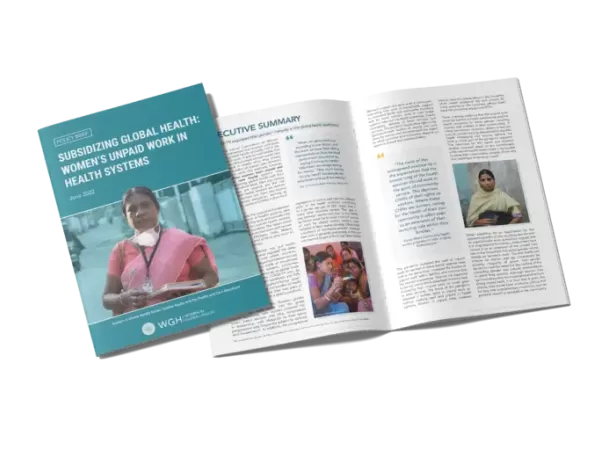
About the brief
We asked our diverse network of chapter members to draw on their lived experiences of the pandemic and recommend concrete national-level policies, actions, activities, and programs related to women health workers that governments should implement to better prepare for and respond to future pandemics. Feedback from representatives from 37 WGH Chapters in 31 countries- comprising health workers, academics, policymakers, non-governmental organizations, government representatives, and students- informed the recommendations of this policy brief.
Their insights reflect both common global concerns and region-specific challenges, highlighting the need for comprehensive policies that address the gender-specific needs of women health workers while considering regional and individual variations. The survey data (in quotes) and the results of our qualitative analysis form the foundation for the evidence-based recommendations presented in this policy brief. Key themes emerged that were common across countries with diverse socio-economic statuses and cultural contexts.

Key Recommendations 
- Governments must prioritize women health workers and their safety
- Governments must invest in capacity building of women health workers to respond in pandemics
- Health systems must become more gender-responsive
- Governments must conduct regular risk assessment of health systems infrastructure and the workforce
- Governments must ensure better working conditions, benefits, and incentives for women health workers
- Governments must invest in innovative, collaborative and gender-responsive research
- Governments must improve coordination and dissemination of information
Acknowledgements 
This work was carried out with the aid of a grant from the International Development Research Centre, Ottawa, Canada. The views expressed herein do not necessarily represent those of IDRC or its Board of Governors.