Women in Global Health’s Statement for International Women’s Day
8 March 2026
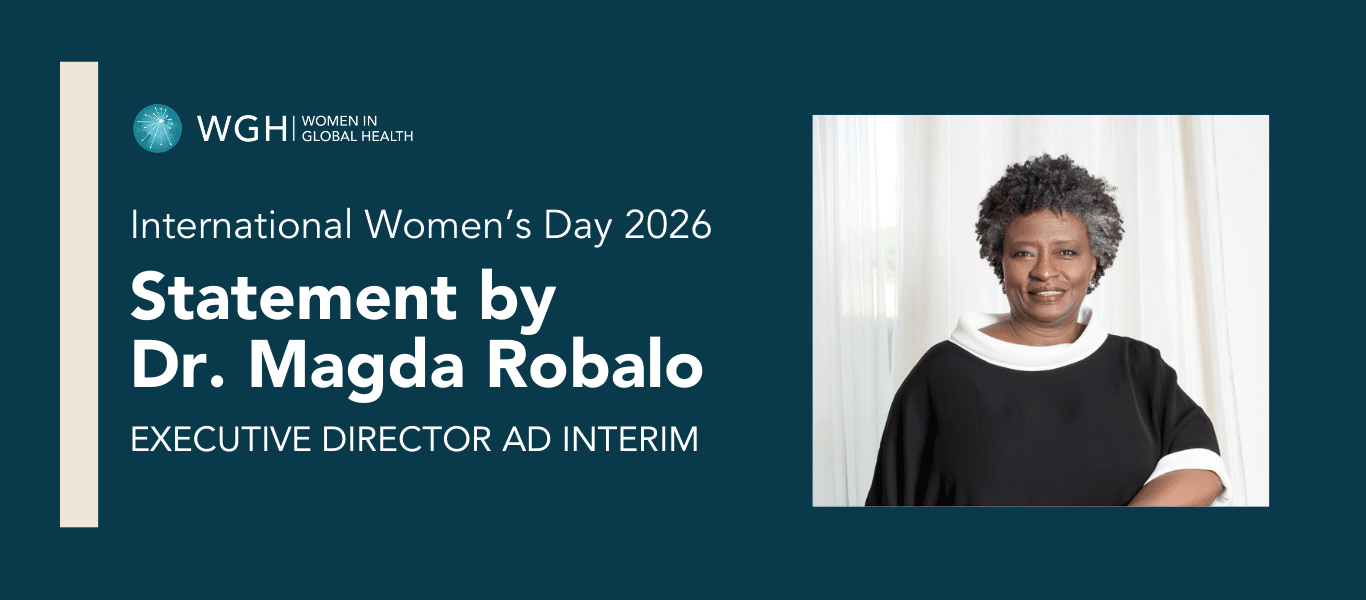
Statement by Dr. Magda Robalo
Executive Director, Women in Global Health
International Women’s Day 2026
On International Women’s Day, a moment for both celebration and accountability, the global community must confront a stark reality: women’s health remains under-researched, underfunded, and underserved. Despite longstanding global commitments, progress towards gender equality and health equity is unacceptably slow. A shifting global landscape, marked by fiscal austerity, declining official development assistance, economic instability, climate shocks, protracted conflict, and democratic erosion, threatens to reverse hard-won gains in gender equality and health equity. Without urgent and coordinated action, the world is not on track to achieve Sustainable Development Goal (SDG) 3 on health and well-being or SDG 5 on gender equality by 2030. Addressing gender and health inequities is a matter of justice.
Although women tend to outlive men, this longevity masks a profound injustice: women spend approximately 25 percent more of their lives in poor health, averaging nearly nine years with illness or disability. This health gap limits women’s participation in the workforce and community life and undermines economic security and broader social development. Increased longevity also means that women’s reproductive years represent a smaller proportion of their lives, underscoring the need for high-quality, comprehensive care across the life course. Closing the gap created by the additional years women spend in poor health could add at least US$1 trillion to the global economy annually by 2040 while improving well-being across generations.
These disparities are not accidental. They are the consequence of structural determinants, including entrenched gender norms, unequal economic systems, and exclusionary governance structures, that shape how health systems are designed and who has power within them. Discriminatory laws, policies, and institutional practices continue to restrict women’s access to care and their participation in decision-making. Women remain overrepresented in frontline health and care roles yet underrepresented in leadership spaces where priorities, budgets, and reforms are determined. Gender bias also shapes research agendas, innovation pathways, data systems, and service delivery, while unpaid and underpaid care work constrains women’s economic security and career advancement.
Weak accountability mechanisms and the inadequate integration of gender across health governance and financing continue to slow progress toward Universal Health Coverage (UHC). Without deliberate systemic reform, including inclusive governance, gender-responsive financing, and enforceable accountability, health systems risk reproducing the very inequalities they are meant to address. Governance arrangements are not gender-neutral. When policies, budgets, and oversight mechanisms fail to account for gendered realities, they reinforce structural disadvantage.
Closing the women’s health gap requires translating commitments into measurable action. Gender-responsive health governance must include clear definitions of women’s health priorities, time-bound targets, and strong accountability mechanisms that track progress and ensure implementation. Public financing must align with policy commitments by systematically assessing women’s health needs across the life course, identifying service gaps, and investing in comprehensive care, including services addressing gender-based violence and other conditions that disproportionately affect women.
Embedding gender analysis within health policy, financing, and accountability systems is therefore essential for justice to prevail. When designed intentionally, health systems can do more than deliver services—they can help transform unequal norms, roles, and power relations. Strengthening gender-responsive governance and accountability positions health systems not only as providers of care, but as drivers of gender equality, social justice, and sustainable development.
On this International Women’s Day, Women in Global Health calls on governments, multilateral institutions, donors, civil society and the private sector to invest in gender-responsive health systems, strengthen women’s leadership and participation in decision-making, and ensure that accountability mechanisms translate commitments into action. Achieving gender equality in health is not only a matter of rights and justice, it is essential to building resilient, equitable health systems and a healthier, more just world for all.


