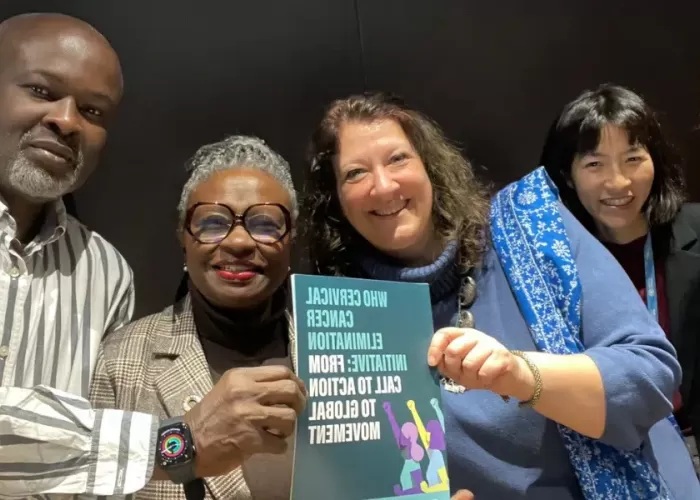
Dr. Hyewon Lee is a pediatric dentist and director at the Global Maternal and Child Oral Health Center at the Seoul National University Dental Research Institute and School of Dentistry. She is a leading advocate for integrating oral health into maternal and child health systems globally and has a special heart for Kenya.
Clare Szalay Timbo is a professional trainer specializing in eye health workforce development and gender equity. Her expertise spans capacity building, health systems strengthening, and promoting equity in eye and reproductive health services, with particular focus on maternal and child populations. She has a special heart for Sierra Leone.
The authors met through the Women in Global Health Speakers Bureau training , where they discovered their shared passion for integrated approaches to maternal and child health. This collaborative article represents their commitment to breaking down silos between oral health, eye health, and primary care to create more comprehensive and equitable healthcare systems for mothers and children.
The Interconnected Foundation: Why Integration Matters
The Oral Health Connection
A mother’s oral health, knowledge, behaviors, and socioeconomic status create a powerful foundation that shapes her children’s lifelong oral health outcomes. Research demonstrates that poor maternal oral health significantly increases caries risk for young children through critical pathways: the direct vertical transmission of cariogenic bacteria from mother to child, and the transfer of health behaviors, knowledge, and resources—what researchers call “health capital”—that mothers and caregivers use to establish optimal oral health environments for their children. Importantly, these maternal factors operate within broader health and healthcare contexts that can either support or constrain a mother’s ability to promote optimal oral health. This profound intergenerational relationship has been extensively documented in scientific literature, leading national clinical guidelines to emphasize that oral health must be an integral component of both antenatal and postnatal care.
The Eye Health Imperative
While eye health is less commonly discussed in maternal and child health (MCH) contexts, its integration into MCH service packages presents a powerful and underutilized opportunity to improve lifelong health outcomes, not only for children but for mothers and families as well. The World Health Organization has identified several evidence-based interventions, such as vitamin A supplementation, screening for congenital cataracts, and timely treatment of retinopathy of prematurity, that can significantly reduce the burden of childhood blindness. Many of these interventions align seamlessly with existing MCH touchpoints, including antenatal care, immunization visits, and early childhood development programs.
For children, early detection and treatment of eye conditions can prevent irreversible visual impairment, support cognitive and motor development, and improve educational outcomes. The benefits extend beyond the child, since when a child’s vision is preserved or restored, it reduces caregiving burdens on mothers and parents, improves family economic resilience, and enhances overall quality of life. Mothers are often the primary caregivers and health decision-makers; equipping them with knowledge and access to eye health services empowers them to advocate for their children’s well-being and seek timely care.
Moreover, integrating eye health into MCH services creates opportunities to address maternal eye health needs as well, such as screening for diabetic retinopathy in pregnant women with gestational or type 2 diabetes, or managing vision changes during pregnancy. This holistic approach strengthens the continuum of care, ensuring that both mothers and children receive comprehensive support.
By embedding eye health into routine MCH services, health systems can reach families at scale, close gaps in access, and promote equity. Eye health integration is not just a clinical imperative, it is a strategic investment in the health, development, and future potential of entire families.
The Current PHC Landscape: Missed Opportunities
Traditional healthcare delivery often operates in silos, with oral health and eye health services separated from primary health care systems and relegated to specialized services. However, prenatal check-ups and well-child visits represent golden opportunities, as mothers come to clinics for health promotion, not merely for treatment of pain or discomfort.
While prevention may seem like a foreign and complex concept to many people from underserved communities, antenatal and postnatal care have always been the cornerstone of primary health care and health promotion, even in resource-limited settings. Pregnant women and most young children, up to five years of age, have frequent contact with trained health personnel at primary health care clinics for health education, monitoring, immunization, and check-ups.
Therefore, it is imperative that oral health and eye health be integrated into primary health care, especially for mothers and children. These existing touchpoints provide natural opportunities to address preventive care, early detection, and health education in ways that can transform long-term health outcomes.
The Path Forward: Policy and Practice Recommendations
The integration of oral and eye health into primary maternal and child healthcare represents more than an efficiency improvement; it embodies a fundamental shift toward truly comprehensive, person-centered care. By positioning oral and eye health services as core components of primary health care, we can prevent unnecessary and devastating healthcare expenditures on oral and eye diseases, as most of these conditions are preventable through early recognition and healthy behaviors.
Past and current approaches that deliver oral and eye health services separately from primary health care have proven insufficient in addressing the global burden of preventable diseases. The evidence clearly demonstrates that fragmented care models fail to reach the populations most in need and miss critical opportunities for early intervention.
Therefore, the question is not whether we can afford to integrate these essential health services, but whether we can afford not to. Every mother and child deserves comprehensive care that addresses their total health needs, including oral and eye health. This integration requires the development of national guidelines that mandate oral and eye health components in maternal and child health programs, the inclusion of oral and eye health measures within maternal and child health systems such as maternal handbooks and health outcomes measure sets, and the implementation of standardized protocols for oral and eye health screening in primary care settings, supported by capacity-building training for the PHC workforce who deliver maternal and child health services.
From sight to smile, every aspect of health matters, and every mother and child deserves nothing less than the best possible start in life.